As if the post-COVID reality wasn’t challenging enough, electricity consumers in Maharashtra faced a new hurdle: shockingly high post-COVID electricity bills. In June 2020, many residents, businesses, and industries received inflated bills despite their premises remaining closed for much of the billing period. Complaints poured into the offices of distribution companies (Discoms) like MSEDCL, AEML, and TPL, with customers seeking clarity on inexplicably high charges.
Discoms responded by explaining that they issued estimated monthly bills during the lockdown based on average consumption, then adjusted these bills once actual meter readings were taken in June. Although this practice is legally valid when physical meter reading isn’t possible, it sparked widespread anger, fueled further by misinformation circulating on social media.
To help consumers understand the post-COVID electricity billing situation better, I studied relevant documents, analyzed bills, and compared findings across multiple households. Below, I break down common allegations and claims about the billing process.
Key Events Leading to High Bills
 To grasp the timeline that led to these post-COVID inflated electricity bills, consider these milestones:
- 24 March 2020: Nationwide lockdown imposed.
- 30 March 2020: MERC approved annual tariff revisions—a procedural step.
- 1 April 2020: New tariff rates took effect across Maharashtra.
- 1 June 2020: Partial lifting of lockdown; MSEDCL resumed manual meter reading outside containment zones.
- June 2020 onwards: Consumers began receiving unexpectedly high bills.
Allegation 1: Revised Tariffs Applied to Pre-31 March Consumption
Short answer: MSEDCL charged old and new rates correctly based on consumption dates.
Explanation: MSEDCL calculated per-day consumption by interpolating the last pre-lockdown reading with the latest post-COVID reading after lockdown. Units consumed before 31 March were billed at old rates, and units consumed afterward at revised rates. Energy charges, wheeling charges, fixed charges, fuel adjustments, and electricity duty were calculated as per norms. My review of multiple bills confirmed this approach was accurate.
Allegation 2: Deducting Monetary Value Instead of Units
Short answer: The impact of deducting monetary value or units is the same.
Explanation: Some alleged MSEDCL deducted only the monetary value of earlier bills when calculating new charges, not the units themselves. But since energy charges, wheeling charges, and related costs directly correspond to units consumed, both methods yield the same bill amount. This argument holds only if March or April consumption was significantly higher than May, which is unverifiable since consumption was averaged.
Allegation 3: Low Average Consumption Considered During Lockdown
Short answer: MSEDCL based estimates on average winter consumption, which was lower than typical summer usage.
Explanation: MSEDCL used the average of three winter months (December-February) to estimate usage during lockdown. Given that electricity consumption spikes in India’s summer months, this led to underestimation of actual usage, causing a sharp correction—and higher bills—when readings resumed in June. Analysis of 12 households’ data from March 2019 to February 2020 shows clear seasonal consumption trends. Following is the chart;
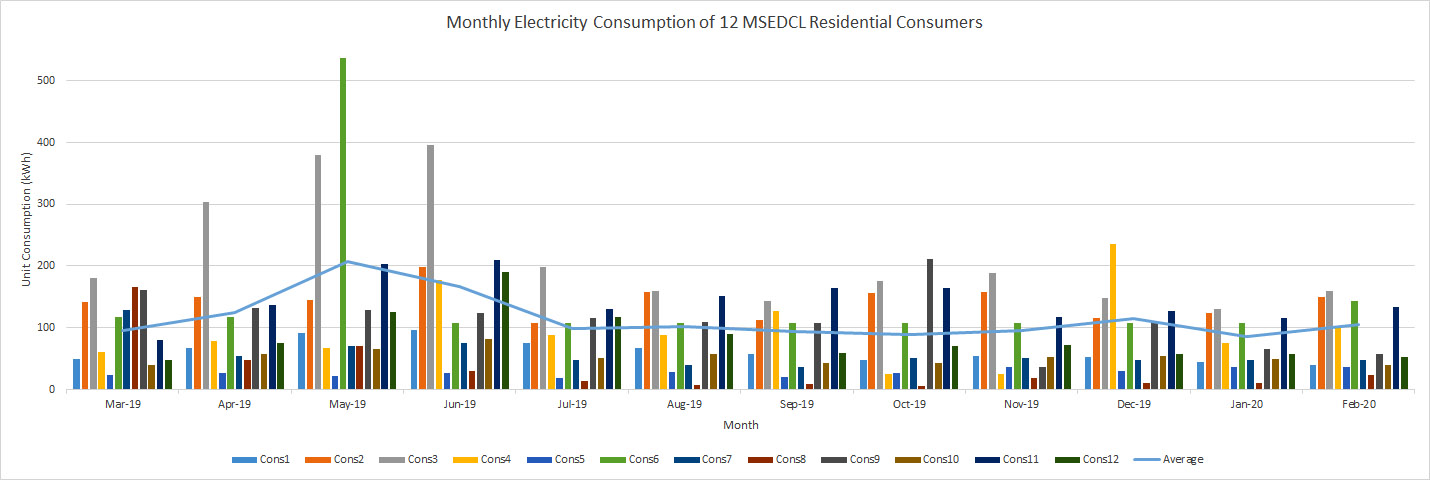
- Monthly Electricity Consumption of 12 MSEDCL Residential Consumers (Source: Author’s Work)
The chart clearly shows significantly higher usage during summer months compared to winter. While the sample size is too small for statistical generalization, it demonstrates that summer averages would have produced a more accurate estimate. This underestimation is a key factor behind the sudden billing spike, which shocked many consumers when actual readings resumed.
Claim 1: Online Meter Reading Was Available During Lockdown
Short answer: Online meter reading submission was disabled until late May.
Explanation: Despite MSEDCL’s claim, the online reading submission option in its app and website remained inactive until late May. I personally attempted submissions multiple times during lockdown without success. Even when I contacted MSEDCL via Twitter in early May, the provided link was inaccessible. Only about 1.5% of consumers self-submitted readings during lockdown, highlighting issues with either system availability or consumer awareness.
You can refer to the screenshot of the embedded tweet and the company’s response in case the original tweet from Twitter goes missing!
The facility is not available. kindly enable it for all pic.twitter.com/Fn0bl9rfF1
— Pratik Joshi (@Pratik_YoursPJ) May 3, 2020
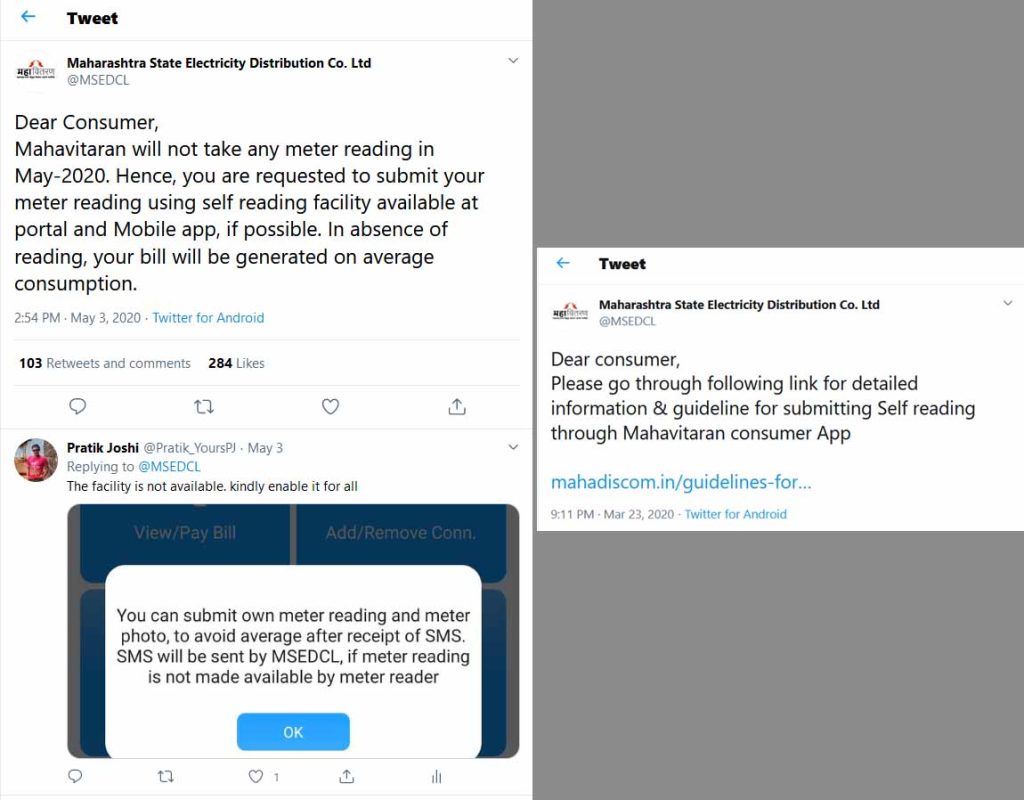
- Screenshot of a Tweet of a conversation with MSEDCL
MSEDCL later stated that only 3.65 lakh out of 2.3 crore consumers self-submitted readings, representing just 1.5% of all customers. This surprisingly low figure suggests either technical issues with the submission system or a lack of promotion by MSEDCL. Consequently, I find MSEDCL’s claim of having effectively facilitated online meter reading during lockdown unconvincing; it was only at the end of May that the facility was broadly re-enabled and promoted.
Claim 2: EMI Facility Initiated by MSEDCL
Short answer: MERC ordered all Discoms to provide EMI options.
Explanation: On 29 June 2020, MERC directed all distribution companies to allow consumers to pay inflated bills in three monthly installments if their bills were double the average of March-May. MERC also mandated timely grievance redressal and barred disconnections for unpaid bills under these conditions. Thus, the EMI facility was not a proactive initiative by MSEDCL but a compliance with regulatory directives.
Fun Fact: Automated Meter Reading (AMR) Saved Some Consumers
About 611,000 MSEDCL consumers escaped billing shocks thanks to AMR-enabled meters. These devices automatically send actual consumption data to Discoms, ensuring accurate monthly bills even during lockdown.
The Way Forward
Understanding post-COVID electricity bills in Maharashtra is essential for every consumer. Verify the meter reading on your bill against your actual meter reading. If discrepancies exist, contact your Discom office immediately for corrections.
Educate yourself about how billing works, especially as Fuel Adjustment Charges (FAC) could further raise bills in the coming months. Let me know if you’d like a deep dive into FAC in a future post.
LinkedIn | X (Formerly Twitter)
This article is based on my personal experience with electricity billing and consumption during the nationwide lockdown caused by the COVID-19 pandemic. The thoughts expressed here are contextual and shared in my individual capacity. I extend my gratitude to everyone who contributed their data and opinions for this post.
