On the morning of April 3, 2020, Hon’ble Prime Minister Narendra Modi addressed the nation with a special message. He invited every Indian to switch off lights at 9 PM for 9 minutes on April 5 and light a Diya or candle. The gesture was meant to symbolize unity in the fight against COVID-19.
The announcement quickly sparked discussions across the country, particularly around the implications for electric grid stability. Many expressed concern that the sudden drop and spike in power demand could destabilize the grid or even lead to a blackout.
As an electrical engineer with a Master’s in Electrical Power Systems, I find it important to provide clarity on this matter.
Understanding the Indian Electric Grid
Electricity cannot be stored in large quantities; it must be consumed as soon as it is generated. The electric grid plays a critical role in ensuring this real-time balance of generation and consumption.
India’s grid is a complex, interconnected network of transmission and distribution lines. It includes equipment like transformers, circuit breakers, and switchgear. The national electric grid comprises five major regions—Northern, Eastern, North-Eastern, Western, and Southern—interconnected to form the world’s largest operational synchronous grid.
Grid Operation and Load Management
The Power System Operation Corporation (POSOCO) oversees the management of the national grid through the National Load Dispatch Centre (NLDC) and five Regional Load Dispatch Centres (RLDCs). Each Indian state also has its own State Load Dispatch Centre (SLDC).
These centers continuously monitor and manage the supply-demand balance 24/7. They forecast electricity demand on long-term, medium-term, and short-term bases. Their real-time communication with generating stations and major substations enables dynamic control of active and reactive power. Voltage levels are also maintained through remote adjustments, such as changing transformer tap positions.
Impact of COVID-19 on Power Demand
Some social media narratives suggested that electricity demand had already dropped by 70–80% due to the nationwide lockdown. However, POSOCO’s official data tells a different story.
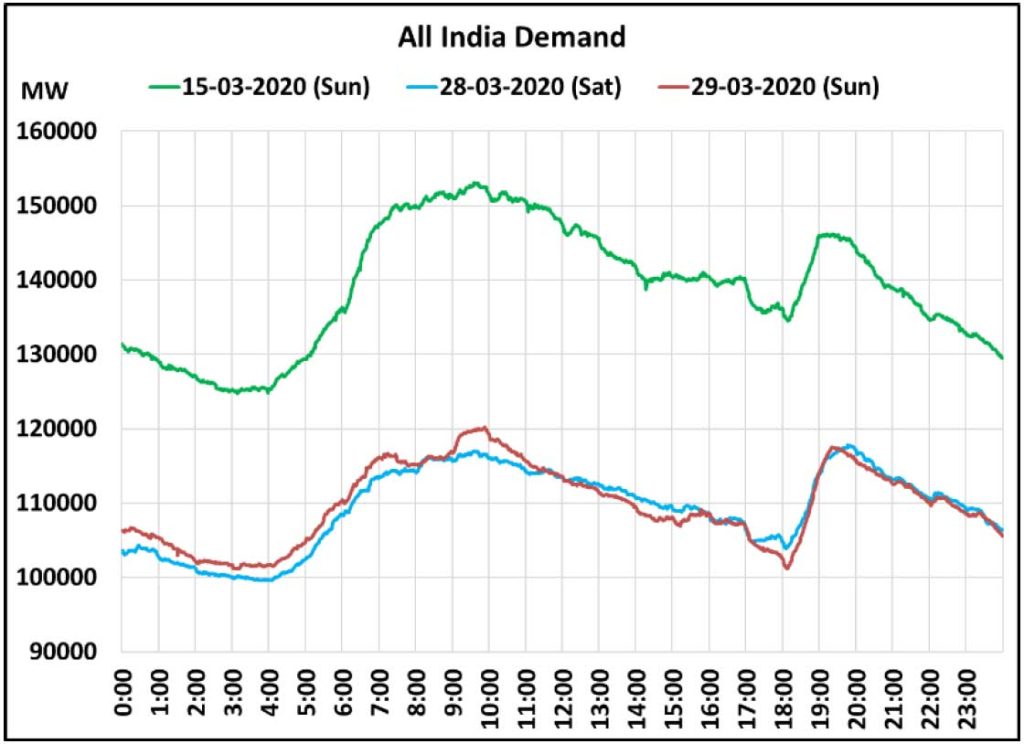
According to the All India Demand Comparison Report published on March 29, 2020, the overall demand had only decreased by around 20%. The Western region saw the highest reduction at approximately 29%. This modest drop is likely due to increased residential usage and seasonal changes, which partially offset the decline from industrial and commercial sectors. The following table shows region-wise load demand comparison between 15 March 2020 and 29 March 2020 by POSOCO.
Table: Region-wise load demand comparison between 15 March 2020 and 29 March 2020 by POSOCO
| Date | Energy Consumption (GWh) | |||||
| Northern Region | Western Region | Southern Region | Eastern Region | North-Eastern Region | All India | |
| 15-Mar-20 | 763 | 1108 | 1064 | 340 | 40 | 3316 |
| 28-Mar-20 | 579 | 781 | 900 | 333 | 36 | 2628 |
| 29-Mar-20 | 598 | 785 | 897 | 325 | 34 | 2639 |
| Change 29-Mar vs 28-Mar | 3.3% | 0.5% | -0.4% | -2.3% | -4.4% | 0.4% |
| Change 29-Mar vs 15-Mar | -21.7% | -29.2% | -15.7% | -4.4% | -14.5% | -20.4% |
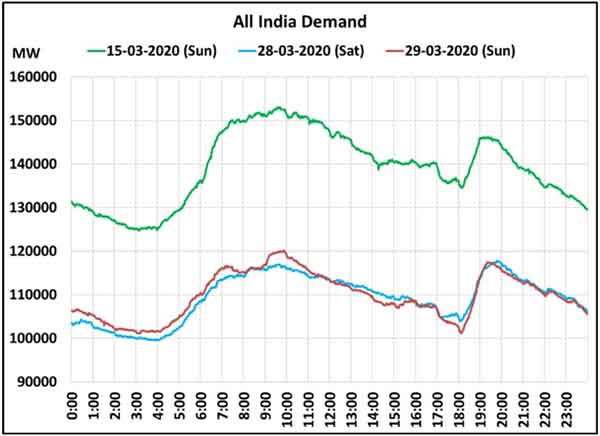
The graph below illustrates POSOCO’s comparison of load demand between 15 March and 29 March 2020. The relatively modest reduction is likely due to increased residential consumption and seasonal variations. A more detailed data analysis would provide deeper insight into these trends.
Assessing the Sunday Night Event
The 9 PM lights-out event on April 5 was not an unplanned disruption. Power system engineers had time to prepare, with various internal circulars and operational guidelines issued in advance. This situation is similar to the annual Earth Hour, where citizens voluntarily reduce electricity usage in a coordinated way.
Moreover, essential services such as hospitals, street lighting, and critical infrastructure continued operating normally. The call was only for residential users to switch off lighting loads, which form a small part of the overall demand.
While no system is entirely immune to risk, the likelihood of grid failure on April 5 was no greater than on any other day. Engineers and planners were equipped with the necessary tools and strategies to manage such fluctuations.
Final Thoughts
India’s electric grid has the resilience to withstand planned, temporary fluctuations in demand, especially when only lighting loads are involved. The 9 PM blackout was both symbolic and technically manageable.
So yes, you could safely switch off your lights and light a Diya or candle to express solidarity in our collective fight against COVID-19. The stability of India’s electric grid was never truly at risk.
Link to POSOCO report: 29 March 2020 Demand Comparison
